Does planking burn belly fat? The honest answer is no, not directly.
Planks can strengthen your core, improve body control, and help you build better posture during exercise. But planking by itself does not specifically burn fat from your stomach.
That does not mean planks are useless. It means they have a different job.
If your goal is to lose belly fat, planks can be part of a good workout plan. But they need to be combined with full-body strength training, cardio, daily movement, recovery, and nutrition habits that support overall fat loss.
For beginners, this distinction matters. You do not need to hold a plank until you shake for three minutes. You need to learn how to train your core safely and build a routine you can repeat.
Does Planking Burn Belly Fat?
Planking does not directly burn belly fat.
A plank is a core-strengthening exercise. It trains your body to hold a stable position while your muscles work to resist movement.
Mayo Clinic explains that abdominal exercises can strengthen and tone the belly muscles, but those exercises alone will not get rid of belly fat. Visceral fat responds to the same diet and exercise strategies that help reduce overall body fat. Mayo Clinic: Belly Fat
So if you do planks every day, your core may become stronger. You may feel more stable. You may improve how your body holds posture during push-ups, squats, martial arts training, or daily movement.
But if your overall body fat does not change, planks alone will not reveal a flat stomach.
The better way to think about it is this:
- Planks build core strength.
- Fat loss comes from overall energy balance and consistent activity.
- Belly fat reduces as total body fat reduces.
- You cannot choose one body part to lose fat from first.
What Planks Actually Do
A plank trains your core to resist collapse.
That sounds simple, but it is useful.
During a good plank, your body works to keep your ribs, pelvis, spine, shoulders, and hips controlled. Cleveland Clinic notes that planks work several muscles, including your abdominals, back, shoulders, chest, glutes, and legs. Cleveland Clinic: Plank Exercise Benefits
For beginners, planks may help with:
- Core endurance
- Posture control
- Shoulder stability
- Glute engagement
- Better bracing during exercise
- Better control during push-ups, squats, and carries
- More awareness of body position
Planks are not magic. But they are a practical beginner exercise when done correctly.
Why Planks Feel Like a Belly Fat Exercise
Planks are often marketed as a belly fat exercise because they make your abdominal area work hard.
When you hold a plank, your core may burn. Your stomach may shake. You may feel pressure through your abs.
That feeling can make it seem like your body is burning fat from that exact area.
But muscle burn and fat loss are not the same thing.
The burning feeling usually comes from muscle fatigue. Your core muscles are working to hold position.
Fat loss happens more gradually through your overall training, food intake, daily activity, sleep, and consistency.
This is why someone can have strong abs but still carry belly fat over them.
The muscles can be trained, but the fat layer changes through overall fat loss.
A Quick Beginner Self-Check
Before adding planks to your workout, use this quick check.
If Your Lower Back Hurts During Planks
Your plank may be too hard or your hips may be sagging.
Start with an easier version, such as a wall plank, incline plank, or knee plank.
If Your Shoulders Hurt
Your hands or elbows may be too far forward, or you may not be ready for a long hold.
Try shorter holds and keep your elbows under your shoulders.
If You Hold Your Breath
The plank is probably too intense.
Use shorter sets and breathe slowly.
If Your Whole Body Shakes Immediately
A little shaking can be normal, but if you lose form quickly, the hold is too long.
Do 5–10 second holds instead of forcing 60 seconds.
If You Can Hold a Plank for 2 Minutes but Your Form Is Poor
Longer is not automatically better.
A clean 20-second plank is more useful than a sloppy 2-minute plank.
What I Would Do First
If a beginner asks whether planking burns belly fat, I would not tell them to do planks every day.
I would start with this:
- Learn a safe plank variation.
- Hold it for short, clean sets.
- Add full-body strength training.
- Walk or do low-impact cardio.
- Track consistency, not just plank time.
- Avoid turning core work into punishment.
A beginner does not need extreme ab workouts.
A beginner needs a plan that builds strength and supports fat loss without creating pain, burnout, or confusion.
How to Do a Plank Correctly
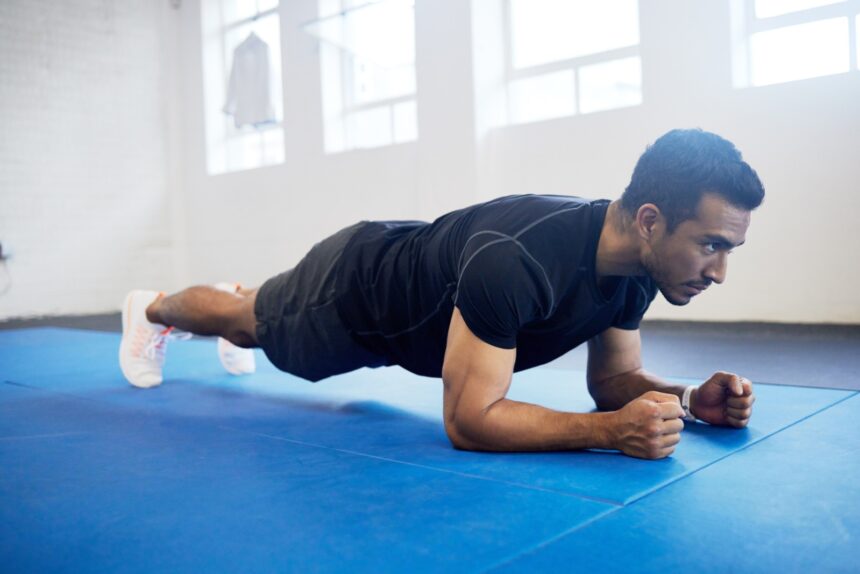
Start with the forearm plank.
Step-by-Step Plank Form
- Place your forearms on the floor.
- Keep your elbows under your shoulders.
- Step your feet back.
- Squeeze your glutes lightly.
- Brace your stomach like you are preparing for a gentle punch.
- Keep your ribs from flaring upward.
- Keep your hips from sagging.
- Look slightly ahead of your hands, not straight forward.
- Breathe slowly.
- Stop before your form breaks.
The plank should feel challenging, but controlled.
You should not feel sharp pain in your lower back, shoulders, wrists, or neck.
How Long Should Beginners Plank?
Most beginners should start with 10–20 seconds per set.
That may sound short, but it is enough if the form is good.
Try this:
- 3 sets of 10 seconds
- Rest 30–60 seconds between sets
- Repeat 2–3 times per week
If that feels easy, progress to:
- 3 sets of 15 seconds
- Then 3 sets of 20 seconds
- Then 3 sets of 30 seconds
You do not need to rush toward a 2-minute plank.
For many beginners, a clean 30-second plank is already useful.
Beginner Plank Variations
Not every beginner should start on the floor.
Choose the version that lets you keep good form.
Wall Plank
Place your forearms or hands on a wall and step your feet back slightly.
This is the easiest option.
Use it if floor planks feel too hard or uncomfortable.
Incline Plank
Place your hands on a bench, table, or sturdy surface.
The higher the surface, the easier the plank.
Use it if you want something harder than a wall plank but easier than the floor.
Knee Plank
Set up like a regular forearm plank, but keep your knees on the floor.
Keep your body straight from shoulders to knees.
Use it if your lower back sags during a full plank.
Full Forearm Plank
Use this when you can hold easier versions with good control.
Keep the hold short at first.
Side Plank From Knees
Lie on your side with your knees bent. Support yourself on your forearm and lift your hips.
This trains the side of your core.
Start with 5–15 seconds each side.
A Simple Beginner Core Workout
This workout is for beginners who want stronger abs and better core control.
It is not a belly fat shortcut. It is a safe core-strength routine.
Do this 2–3 times per week.
Beginner Core Circuit
Complete 2 rounds:
- Knee plank — 10–20 seconds
- Dead bug — 6 reps each side
- Glute bridge — 10 reps
- Bird dog — 6 reps each side
- Side plank from knees — 5–15 seconds each side
Rest 30–60 seconds between exercises.
Move slowly. Keep the goal simple: control.
If your form gets worse, stop the set.
How to Combine Planks With Fat-Loss Exercise
If your goal is belly fat loss, planks should be part of a larger plan.
The CDC recommends that adults aim for at least 150 minutes of moderate-intensity physical activity per week and two days of muscle-strengthening activity. CDC: Adult Physical Activity Guidelines
A beginner-friendly plan could look like this:
Weekly Plan
Day 1: Full-Body Strength + Core
- Chair squat
- Incline push-up
- Dumbbell or backpack row
- Glute bridge
- Knee plank
Day 2: Easy Cardio
- 20–30 minutes of walking, cycling, or low-impact cardio
Day 3: Rest or Gentle Mobility
- Light stretching
- Easy walk if it feels good
Day 4: Full-Body Strength + Core
- Step-up
- Wall push-up
- Hip hinge drill
- Bird dog
- Side plank from knees
Day 5: Cardio
- 20–30 minutes at a pace where you can still speak in short sentences
Day 6: Optional Movement
- Walking
- Mobility
- Light recreational activity
Day 7: Rest
This is more useful than doing long planks every day.
Beginner Example 1: The Person Doing Planks Every Night
A beginner wants to lose belly fat, so they start holding a plank every night.
They do three one-minute planks, but their lower back starts hurting. They are not doing cardio, strength training, or much walking.
What they are likely doing wrong:
- Treating planks as a fat-loss shortcut
- Holding planks too long with poor form
- Ignoring full-body training
- Not increasing daily movement
What they changed:
- Knee planks for 3 sets of 15 seconds
- Two full-body strength workouts per week
- Three 20-minute walks per week
- Dead bugs and glute bridges for better core control
What progress may look like after 2–4 weeks:
- Less lower-back discomfort
- Better plank form
- More consistent movement
- Improved workout confidence
- Better awareness of posture and bracing
The main improvement is not instant belly fat loss. It is building a routine that can actually support fat loss over time.
Beginner Example 2: The Home Trainee With Limited Time
A beginner has only 20 minutes to exercise at home.
They want a flatter stomach, so they search for planks for belly fat. They try long plank holds but get bored and inconsistent.
What they are likely doing wrong:
- Depending on one exercise
- Not training the full body
- Skipping cardio completely
- Making the workout too repetitive
What they changed:
They started a 20-minute home routine:
- 5 minutes warm-up
- 10 minutes full-body circuit
- 5 minutes core work
Their circuit includes squats to a chair, wall push-ups, glute bridges, marching in place, and knee planks.
What progress may look like after 2–4 weeks:
- More consistent workouts
- Better endurance
- Stronger core
- Better movement quality
- More motivation to continue
This is a better beginner approach because it trains more than one muscle group.
Beginner Example 3: The Martial Arts Beginner
A beginner starts boxing or kickboxing and wants better core strength.
They ask if planking will burn belly fat because they feel their abs working during class.
What they are likely missing:
- Planks may help with bracing
- Fat loss still depends on overall habits
- Core strength helps movement, but it is not the same as fat loss
- Conditioning and recovery matter too
What they changed:
- Short planks after class, not before hard training
- Side planks for trunk control
- Walking on off days
- Two strength sessions per week
- Better pacing during class
What progress may look like after 2–4 weeks:
- Better posture during stance work
- More stable punches and kicks
- Less lower-back fatigue
- Better breathing during training
- More consistent weekly activity
For martial arts students, planks are useful because they support control. They are not a shortcut to visible abs.
Common Mistakes and Simple Fixes
Mistake 1: Thinking Planks Melt Belly Fat
Planks train your core muscles. They do not directly melt fat from your stomach.
Simple fix: Use planks for core strength, and use full-body training plus cardio for fat-loss support.
Mistake 2: Holding Planks Too Long
Long holds often turn into poor form.
Simple fix: Use shorter, cleaner holds. Stop before your hips sag or your lower back takes over.
Mistake 3: Holding Your Breath
Many beginners brace so hard that they stop breathing.
Simple fix: Breathe slowly through the hold. If you cannot breathe, the plank is too hard.
Mistake 4: Letting the Hips Drop
Sagging hips can stress the lower back.
Simple fix: Squeeze your glutes lightly and shorten the hold.
Mistake 5: Doing Only Core Work
Core work is useful, but it is not enough for overall fat loss.
Simple fix: Add squats, push-ups, rows, hinges, carries, walking, or other full-body movement.
Mistake 6: Training Abs Every Day While Ignoring Recovery
Your core muscles also need recovery.
Simple fix: Do core training 2–4 times per week and keep it controlled.
How to Progress Safely
Progress planks slowly.
A safe beginner progression could look like this:
Week 1
- Wall plank or knee plank
- 3 sets of 10 seconds
- 2–3 times per week
Week 2
- Knee plank or incline plank
- 3 sets of 15 seconds
- Add dead bugs or bird dogs
Week 3
- Knee plank or full plank
- 3 sets of 20 seconds
- Add side plank from knees
Week 4
- Full plank if form is clean
- 3 sets of 20–30 seconds
- Keep breathing steady
Progress is not just longer holds.
Progress also means:
- Better breathing
- Less shaking
- Less back tension
- Better control
- Better form during other exercises
When to Stop or Modify
Stop or modify planks if you feel:
- Sharp lower-back pain
- Shoulder pain
- Wrist pain
- Neck strain
- Numbness or tingling
- Dizziness
- Unusual shortness of breath
- Pain that gets worse as you continue
Modify by choosing:
- Wall plank
- Incline plank
- Knee plank
- Shorter holds
- Longer rest
- Dead bug instead of plank
- Bird dog instead of plank
Do not force a plank just because it looks simple.
Simple exercises can still be too difficult if the variation is not right for your current level.
Who Should Be Cautious
Be careful with planks if you:
- Have current back pain
- Have shoulder or wrist issues
- Are recovering from injury
- Are pregnant or recently postpartum
- Have been told to avoid certain core exercises
- Feel pressure, pain, or unusual symptoms during core work
- Cannot hold the position without your lower back sagging
If you have pain, injury, breathing symptoms, or a medical condition, ask a qualified professional before starting or changing your training.
What to Track Instead of Plank Time
Plank time is not the only progress marker.
Track:
- Can you hold better form?
- Can you breathe while bracing?
- Does your lower back feel okay?
- Are you walking more each week?
- Are you strength training consistently?
- Are your workouts easier to repeat?
- Are your clothes fitting differently?
- Is your waist measurement changing over time?
For belly fat goals, a weekly waist measurement is often more useful than a daily plank timer.
Measure at the same time of day, under similar conditions, and do not obsess over daily changes.
Coach’s Note
A coach would not use planks as a belly fat test.
A coach would use planks to see whether a beginner can brace, breathe, and hold body position.
If a beginner cannot hold a plank without back pain, the answer is not “try harder.” The answer is to choose an easier variation and build control.
For fat loss, a coach would also look at the full picture:
- Weekly training
- Daily movement
- Food habits
- Sleep
- Recovery
- Stress
- Consistency
Planks can help. But they are one tool, not the whole toolbox.
Black Belt Guy Training Perspective
This article is written for beginners who want practical, safe, no-confusion training guidance.
The goal is to explain what planks can and cannot do, especially for readers who want to lose belly fat without falling for spot-reduction myths or unsafe ab challenges.
The advice focuses on realistic progressions, clear decision-making, and safe core training for beginners, home trainees, fitness enthusiasts, and martial arts students.
This article is general education and does not replace coaching, physical therapy, or medical advice.
Editorial note: This article is for general fitness education. It is not medical advice. If you have pain, injury, breathing symptoms, or a medical condition, ask a qualified professional before starting or changing your training.
FAQ
Does planking burn belly fat?
No, planking does not directly burn belly fat. Planks strengthen your core, but belly fat reduces through overall fat loss, not one targeted exercise.
Can planks make your stomach flatter?
Planks may help your core feel stronger and more controlled, which can improve posture. But a visibly flatter stomach usually depends on overall body fat, food habits, activity level, and consistency.
How long should I plank to lose belly fat?
There is no plank time that directly causes belly fat loss. Beginners can start with 3 sets of 10–20 seconds and focus on good form. For fat-loss support, combine planks with cardio, strength training, walking, and healthy eating habits.
Is a 1-minute plank good for beginners?
A 1-minute plank is good only if your form stays clean. If your hips sag, your lower back hurts, or you hold your breath, shorter sets are better.
Are planks better than sit-ups?
Planks and sit-ups train the core differently. Planks are often easier to control for beginners, while high-rep sit-ups may bother some people’s neck or lower back. Choose the exercise you can do safely.
Should I plank every day?
You can practice easy planks often if they do not cause pain, but most beginners do not need hard planks every day. Two to four core sessions per week is usually enough to start.
What plank is best for beginners?
Wall planks, incline planks, and knee planks are good beginner options. Choose the version that lets you breathe and hold a straight body position without pain.
What should I do instead of only planks?
Use planks with full-body strength exercises, walking, low-impact cardio, and beginner core exercises like dead bugs, bird dogs, glute bridges, and side planks from knees.
Sources and Further Reading
- Mayo Clinic: Belly Fat — Explains that abdominal exercises can strengthen muscles but do not remove belly fat by themselves.
- Mayo Clinic: Belly Fat in Men — Provides additional general guidance on belly fat, waist measurement, and health risk.
- Cleveland Clinic: Plank Exercise Benefits — Explains what planks do, what muscles they train, and how to think about plank safety.
- CDC: Adult Physical Activity Guidelines — Provides general weekly activity guidance for adults, including cardio and muscle-strengthening recommendations.
Conclusion
So, does planking burn belly fat?
Not directly.
Planks strengthen your core, improve body control, and can support better movement. But belly fat loss depends on overall fat loss, not one ab exercise.
Use planks as part of a bigger beginner plan.
Do full-body strength training. Walk more. Add low-impact cardio. Sleep enough. Eat in a way that supports your goals. Progress slowly.
A stronger core is useful.
But the real win is building a routine you can repeat.