
You’ve been training for weeks.
You show up, you sweat, you try your best—but the weights don’t feel lighter. Your reps don’t increase. It feels like you’re stuck.
This is one of the most common problems in fitness.
The good news is, it’s almost always fixable.
By the end of this guide, you’ll understand why strength gains slow down, what mistakes to avoid, and exactly how to start progressing again—safely and consistently.
The Basics (Beginner Explanation)
Strength doesn’t increase randomly.
Your body gets stronger through a process called progressive overload, which means gradually making your workouts more challenging over time.
Here’s how it works in real life:
- You stress your muscles through exercise
- Your body repairs and adapts
- Next time, your muscles are slightly stronger
Key terms explained simply:
- Progressive overload: Slowly increasing difficulty so your body keeps adapting.
- Recovery: The time your body uses to repair and grow stronger after training.
- Plateau: A period where progress stops or slows down.
If any part of this process is missing, your strength will stall.
Quick Takeaway
- Strength comes from stress + recovery.
- You must gradually increase difficulty.
- Plateaus are normal and fixable.
- Small improvements matter more than big jumps.
Why This Matters (Performance, Safety, Longevity)
Getting stronger isn’t just about lifting heavier weights.
- Strength supports all movement
Strong muscles improve daily activities and athletic performance. - Reduces injury risk
Weak muscles fatigue faster and increase the chance of poor form. - Builds confidence
Seeing progress helps you stay motivated and consistent. - Improves long-term health
Strength training supports joints, bones, and overall function. - Prevents burnout
Understanding progress helps you train smarter, not harder.
Quick Takeaway
- Strength improves performance and safety.
- Progress builds confidence and motivation.
- Training smart prevents burnout.
- Long-term health depends on strength.
Exercises / Methods / Techniques
These exercises build strength effectively—but only if done correctly and progressively.
Bodyweight Squats
What it helps with:
Builds lower body strength and teaches proper movement patterns.
What you’ll feel working:
Your thighs, hips, and glutes.
How to do it:
- Stand with feet shoulder-width apart.
- Keep your chest upright.
- Push your hips back slowly.
- Bend your knees and lower your body.
- Keep your heels flat on the ground.
- Lower until thighs are parallel.
- Pause briefly.
- Push through your heels to stand.
Breathing:
Breathe in as you lower, and out as you stand.
Common mistakes (with fixes):
- Knees collapsing inward → Push knees outward slightly.
- Heels lifting → Focus on pressing through heels.
- Rushing reps → Slow down for better control.
Make it easier (beginner option):
- Use a chair for support.
- Do partial squats.
- Hold onto a wall.
Make it harder (progression):
- Add weights.
- Slow tempo.
- Add a pause at the bottom.
Best for:
Beginners and athletes; modify if you have knee issues.
Push-Ups
What it helps with:
Builds upper body pushing strength.
What you’ll feel working:
Chest, shoulders, and arms.
How to do it:
- Place hands slightly wider than shoulders.
- Keep your body straight.
- Lower your chest toward the floor.
- Keep elbows slightly tucked.
- Lower until chest is near the ground.
- Push back up.
- Keep your core tight.
Breathing:
Inhale down, exhale up.
Common mistakes (with fixes):
- Hips sagging → Tighten your core.
- Elbows flaring → Keep them closer to your body.
- Shallow reps → Lower fully.
Make it easier (beginner option):
- Knee push-ups.
- Incline push-ups.
Make it harder (progression):
- Decline push-ups.
- Slower reps.
- Add pause.
Best for:
All levels; scale based on strength.
Quick Takeaway
- Squats and push-ups are foundational.
- Form matters more than speed.
- Progress by increasing difficulty gradually.
- Track small improvements.
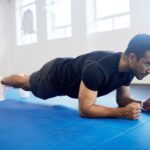
Plank Hold
What it helps with:
Improves core strength and stability.
What you’ll feel working:
Abs, shoulders, and lower back.
How to do it:
- Place forearms on the ground.
- Keep elbows under shoulders.
- Extend legs back.
- Keep body straight.
- Tighten core.
- Hold position.
Breathing:
Breathe steadily without holding your breath.
Common mistakes (with fixes):
- Hips dropping → Raise hips slightly and tighten core.
- Holding breath → Focus on steady breathing.
- Neck strain → Look downward.
Make it easier (beginner option):
- Knees on ground.
- Shorter holds.
Make it harder (progression):
- Longer holds.
- Lift one leg or arm.
Best for:
All levels; essential for stability.
Dumbbell Rows
What it helps with:
Builds upper back strength and posture.
What you’ll feel working:
Back muscles and arms.
How to do it:
- Hold a dumbbell in one hand.
- Place the other hand on a bench.
- Keep your back flat.
- Pull the weight toward your torso.
- Keep your elbow close.
- Lower slowly.
- Repeat on both sides.
Breathing:
Exhale when pulling, inhale when lowering.
Common mistakes (with fixes):
- Rounding back → Keep your back flat.
- Using momentum → Move slowly.
- Pulling too high → Stop at torso level.
Make it easier (beginner option):
- Use lighter weight.
- Reduce reps.
Make it harder (progression):
- Increase weight.
- Slow tempo.
Best for:
All levels; great for posture improvement.
Quick Takeaway
- Core and back strength are essential.
- Control each movement.
- Avoid rushing reps.
- Progress gradually.
Level Guide
Beginner
- Focus on technique first
Proper form prevents injury and builds a strong foundation. - Train 2–3 times per week
This allows recovery and steady progress. - Avoid comparing yourself
Progress is individual and takes time.
Intermediate
- Track your workouts
Logging sets and reps helps ensure progress. - Increase difficulty gradually
Add reps, sets, or weight over time. - Avoid skipping recovery
Progress slows without rest.
Advanced
- Use structured programs
Planned routines improve efficiency. - Focus on weak points
Target muscles that limit your performance. - Avoid training at maximum effort daily
Overtraining reduces progress.
Done-for-You Workouts (Examples)
Home Workout
- Squats: 3×12
- Push-ups: 3×10
- Plank: 3×30 sec
- Rest: 60 sec
Do this 3–4 times weekly for steady progress.
Gym Workout
- Squats: 3×8
- Bench press: 3×8
- Rows: 3×10
- Rest: 60–90 sec
This builds full-body strength efficiently.
Martial Arts-Focused Workout
- Jump rope: 5 min
- Shadowboxing: 3 rounds
- Squats: 3×12
- Plank: 3×45 sec
Improves strength and conditioning for combat.
Safety & Injury Prevention
- Sharp pain
Stop immediately to prevent injury. - Extreme fatigue
Rest to avoid overtraining. - Joint discomfort
Modify exercises or reduce intensity.
How to modify safely
- Reduce weight or reps.
- Slow down movements.
- Use support when needed.
When to rest or seek help
If pain persists or worsens, consult a professional.
Common Mistakes & Misconceptions
- Not increasing difficulty
Happens due to comfort; fix by adding reps or weight. - Poor recovery
Caused by lack of sleep; fix by prioritizing rest. - Inconsistent training
Skipping sessions slows progress; fix by scheduling workouts. - Doing too much too soon
Leads to burnout; fix by progressing gradually.
Mindset & Long-Term Progress
Strength takes time.
Focus on small wins, like one extra rep or better form. That’s real progress.
Consistency matters more than perfection.
Conclusion
If you’re not getting stronger, it’s usually due to missing progression, poor recovery, or inconsistency.
Fix those, and progress will return.
Next Steps
- Track your workouts to ensure progress.
- Focus on recovery as much as training.
- Stay consistent and patient.
Keep showing up, and strength will follow.
FAQ
1. How long does it take to get stronger?
Most beginners see progress within 2–4 weeks.
2. Why do I feel tired but not stronger?
You may be overtraining or not recovering enough.
3. Do I need heavy weights?
Not at first. Proper progression matters more.
4. Can I train every day?
Yes, but include lighter days for recovery.
5. What if I miss workouts?
Just continue your routine without overcompensating.
6. Is soreness required for progress?
No. You can get stronger without feeling sore.
7. Should I change exercises often?
No. Stick to basics and progress them.